Thought and Sketch
How are we to speak of Raymonde Carasco’s two works, Gradiva esquisse I (1978) [hereinafter referred to as Gradiva esquisse] and Julien, portrait d’un voyant (1983) [hereinafter referred to as Julien]? This student of Roland Barthes and Gilles Deleuze undoubtedly brought obscure and rigorous philosophical and semiotic reflections into her filmmaking. The texts Carasco wrote for her films are fraught with metaphysical contemplation and interspersed with references to literary texts, which encounters a significant barrier to the reader’s understanding. Thus, we perhaps cannot avoid the question: Must we understand these texts to understand these films? Or rather, is cinema merely the embodiment of textual ideas?
Let us begin with the manuscript Carasco wrote for Gradiva esquisse. In the form of the manuscript, we might find the very thing that the film’s title suggests to us: esquisse, which should perhaps be translated as a “sketch.” Like the manuscript, it points to a form shaped in haste and imperfection—or rather, a quasi-form, for it has yet to be unraveled and molded into a finished work. Both manuscripts and sketches arise from the urgency of recording that which is given; their unfinished form is the trace of the emergence of matter’s own abundance. Philosophical language is often criticized for being opaque and difficult, but this linguistic difficulty usually stems from the fact that thought itself is difficult; a characteristic that is often particularly evident in manuscripts.
Similar to a sketch, a manuscript concerns the traces inscribed in thought by the thing being thought; the author is captured by something, feeling a compelling necessity to write or to draw. Writing, or drawing, in its most primitive state—that is, in fragmented sentences or rapidly scratched lines—contains the force exerted by the given upon thought. In the acts of writing sentences or drawing lines, what is vital is how to begin, how to faithfully confront the immediacy of this givenness. Therefore, akin to a sketch, a manuscript is often riddled with contradictions, interruptions, and ambiguities (hence the need for parentheses), because thought has not yet found the correct form for the object it depicts, forcing it to begin anew time and again.
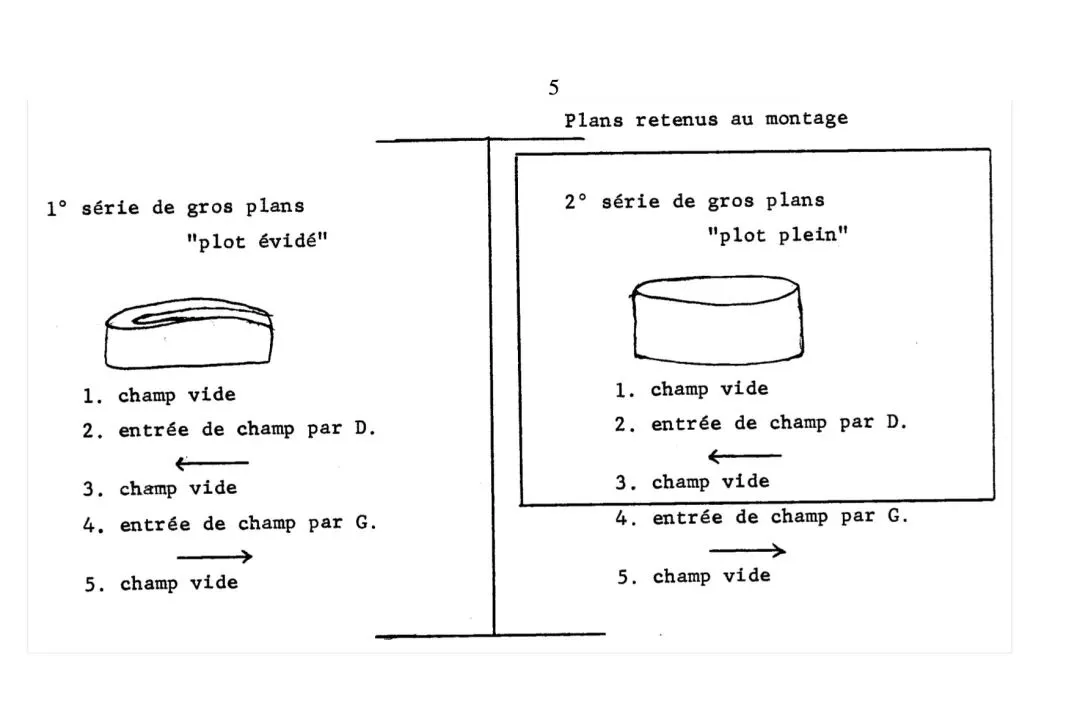
What if, then, we treat this imperfection awaiting form as the form itself? This is precisely what Gradiva esquisse does: it traces a circle, but an incomplete one. Two girls walk past the camera, again and again, in a continuous cycle; yet each time, they only pass before the lens. In their unceasing procession, we can only see this single arc of the circle. This is perhaps because what cinema offers is, ultimately, a flat surface; akin to a sketch, it requires a certain capacity to depict things on a plane.
Gradiva esquisse is adapted from Wilhelm Jensen’s novel Gradiva, published in 1903. The novel tells the story of a man’s obsession with a young woman in an ancient Roman bas-relief (whom he names “Gradiva,” meaning “the girl who walks”). Freud used it as material for psychoanalysis to explain the relationship between dreams and repression; Carasco’s intention in filming this short piece, however, lies in liberating this young woman from the masculine hermeneutics of Freudian psychoanalysis. Shot on location in Pompeii—the very place where the girl walks in the novel—the short film places us as if before a stage. Yet, what unfolds upon it is not a historical drama, but merely the continuous walking of two contemporary girls. Unlike psychoanalysis, which transforms the gaze at the walking girl’s gait into a desire for possession and associates the ancient city with a lost spiritual world, the film turns to depict the stargazer’s own non-vouloir-saisir (non-willing-to-grasp).
.BVlPgR3i_Z2cYrC3.webp)
This description stems from Carasco’s account of her later experience filming Indigenous women in Mexico. In these women, she sensed a necessity in every gesture: not a single movement was superfluous; they belonged entirely to the women and their lives, uncatchable by any gaze that sought to distort them. Consequently, the filmmaker loses all authority, left only to record the women’s steps in a state of non-willing.
Similarly, in Gradiva esquisse, what matters is the gait itself rather than a predetermined route. This pace is no longer stared down by a gaze longing to freeze it into an eternal posture. The film simply allows the two girls (rather than that single, solitary one)—Carasco’s two daughters—to tread over silent stones in the heat wave time and again, each time with a slight variation, each time altering the totality of this walking. Every footstep is a delineation of the world; the posture of the sole gripping the ground, the arch of the foot, the interval between steps—all shift our finest perceptions of the world on screen.
It is as if the cinema, starting from what is most taken for granted and thus most neglected, is testing its own capacity to bear walking, this most fundamental of actions. Therefore, the reason it can be called a sketch is precisely because it has not yet found a form, or rather, it does not desire a form to be completed, just as Jean-Luc Nancy once wrote:
The sketch does not disappear into the drawing; on the contrary, drawing exists only insofar as it retains the sketch within it, always released again, drawn, given impetus. 1
Jean-Luc Nancy, The Pleasure in Drawing, 99.
The two girls, or “any girl” as Carasco puts it, cross day and night, walking or running tirelessly along the paths of ancient Pompeii, as if their steps were chasing the rhythm of time. Referencing Dziga Vertov’s concept of “interval”, Carasco sought to create a rhythmic disparity between slow-motion and normal-speed shots, between wide shots and close-ups. Between the ruins that conceal history and the girls’ dreamlike steps, time seems out of joint, advancing at two entirely different tempos. This is a space-time reduced to pure sensory events, a space-time where the viewing gaze has lost all its authority: nothing remains but red walls and white dresses; a foot falls, a lizard leaps. The Gradiva(s) have finally won their own time.
_2.fTbJepLo_1MprRm.webp)
Walking Upon Ruins and Apocalyptic Fires
Similar to Gradiva, Julien is also a film that walks upon ruins. Our protagonist, Julien, is Carasco’s father. Both films encompass a defamiliarization of those close to us: the former through the pure progression of steps in an isolated space-time, the latter through the oral dictation of visions. Julien’s narration is rife with illusions, oracles, and miracles. He says: the Holy Spirit has entered him. He even depicts an apocalyptic scene of the final showdown between good and evil in a world consumed by fire.
Accompanying these near-delirious words, Carasco’s lens sweeps over abandoned houses and the vegetation growing wildly upon them. We are astonished to find that everything within sight seems to have survived the scorching of apocalyptic flames (does it not remind us of the light and fireballs Turner turned to depict in his late period?). In a daze, we cannot distinguish whether these ruins belong to the past or the future. I do not know if the word “Disaster” is appropriate here—in Julien’s murmurs (for he must speak continuously, as he says), we seem to have lost the guidance of all stars, no longer able to discern direction or grasp time; we, who were born after him, can only take his words as the sole credible testimony.
.A9I9Fstv_23Jm1W.webp)
Carasco tirelessly films her father’s walking and running figure. As Julien says: “I like this speed of movement...” What else could delineate a person’s posture better than their gait? In that utterly bizarre chase scene, Julien jogs after a man through woods and hills. They consistently maintain an exact distance between each other, making the scene appear quite comical. This is precisely a playful enactment of Julien’s story, appearing both as an exorcism of this nightmare and a game between father and daughter.
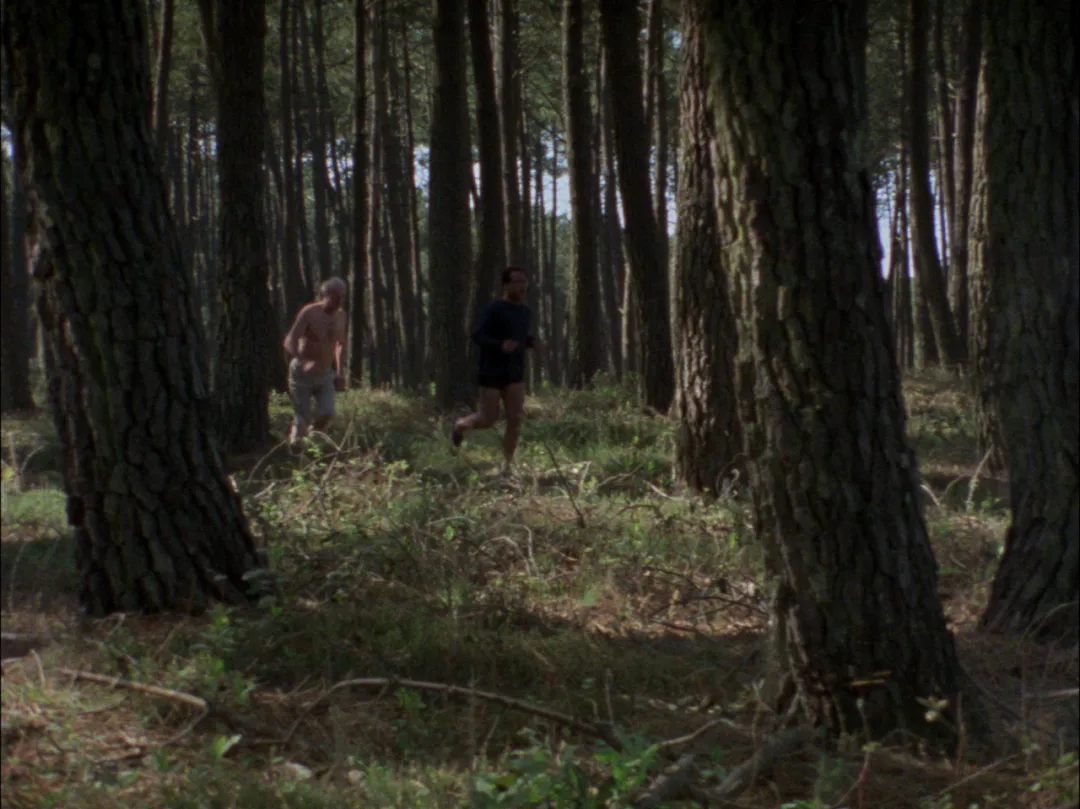
The daughter follows the father, the mother follows the daughter, a French director follows Indigenous women—in Carasco’s films, the shooting of footsteps is always a following of the Other. To relinquish all authority before the Other, to discover the power of the Other’s steps, and to allow oneself to be captured by this power—it is precisely because of this humility that Carasco’s cinema, through a prolonged gaze at the Other, always gains an insight into the beauty of life. This insight carries an unparalleled sensory immediacy that bypasses the programmatic words the author penned for it, forever altering our gaze.
When thought abandons the will to grasp and the pursuit of a perfect form, it finally discovers its own pace: a pace that never walks alone, but one following another; it steps outside of itself, eternally chasing a form yet eternally refusing to catch up to it; it prefers to chase the pace itself, wherein lies the continuation of the work in its incompleteness: désœuvrement.